The VITOTOX test is a test which is more rapid and less expensive than the
“classical” Ames test. The test is also at least as sensitive as the Ames test. It is based on
bacteria that contain the lux operon of Vibrio fischeri under transcriptional control of the recN
gene, that is part of the SOS-system (Scheme 6.1). This gene is normally not transcribed (no
light production) but it will be “switched on” when the bacteria are exposed to a genotoxic
compound (mutagen or “SOS-inducing” substance). Genotoxicity is thus expressed as light
production.
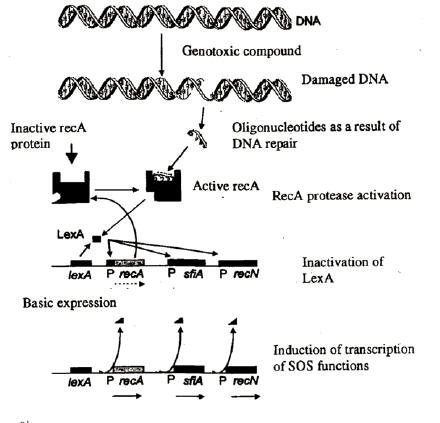
which the VITOTOX test is based (insertion of an operon-less “lux” gene next
to recN results in light production when the bacterial DNA is damaged)
Although any bacterial strain can be used, Salmonella typhimurium strains were chosen as
these are well known for mutagenicity testing and because the same bacteria can also be used
Screening of the Bioactivity of the Isolated Natural Productsfor a classical Ames test.
However, as all Salmonella constructs gave very comparable results,
only the TA104 construct [called T104 (recN2-4)] is used as it was shown to be sometimes a
little bit more sensitive than the other hybrid strains.
As it was realised that some compounds act directly on the light production (e.g., aldehydes)
or enhance the metabolism of the bacteria creating false-positive results, a constitutive light
producing strain with a lux operon under control of the strong promoter pr1 was also
incorporated. This is used as an internal control system, which also gives important
information on the toxicity of the test compound. Major advantages are less sample used, results in 4h.
Is is used in real time with Agilent or LuminMax luminometer.